How to Choose an Influencer Marketing Agency in Dubai: 7 Mistakes to Avoid
A buyer's guide for UAE brands hiring an influencer marketing agency in Dubai. Covers the 7 mistakes brands make, red flags to avoid, pricing models, compliance requirements, and questions to ask before signing.
Written by

Influencer Expert
Reviewed by

Founder & Creative Director
11 min read · Last updated August 16, 2026
By Shawn Munir - CEO, Yamammi
Choosing an influencer marketing agency in Dubai is one of the highest-stakes vendor decisions a UAE brand can make. Most Dubai brands that came to us had already wasted AED 20,000-40,000 on a campaign that went nowhere.
I've reviewed hundreds of agency pitches across Dubai and the GCC. The problems are almost always the same.
The best agency is rarely the one with the biggest creator list. It is the one that tells you how to select creators, manages compliance, tracks performance, and protects your budget.
That's exactly what we do as an influencer marketing agency in Dubai, built around clear pricing and vetted creators.
What an influencer marketing agency actually does
A proper influencer marketing agency in Dubai handles strategy, creator sourcing, audience vetting, brief writing, contracts, content approvals, posting coordination, usage rights, and reporting.
Sounds simple? In practice, this is where most campaigns succeed or fail.
A platform helps you search for influencers. A freelance manager can help with outreach. An agency owns the full process and is responsible when something goes wrong.
A restaurant launch in Dubai Marina needs a completely different type of influencer compared to a wellness brand in DIFC or a product brand selling across the GCC.
Any agency that cannot explain how it picks creators is working from a personal contact list, not a strategy.
Strong Dubai influencer marketing agency vs weak one: what the difference looks like
Here is the difference between a strong influencer marketing agency and a weak one in practice:
What a strong Dubai agency does | What a weak one does |
Shows audience geography data before recommending creators | Sends a shortlist based on follower count |
Raises UAE compliance in the first call | Mentions it only if you ask |
Knows the difference between Dubai-resident and Dubai-based audiences | Uses "Dubai influencer" as the only filter |
Shows case studies with commercial outcomes | Shows reach and engagement screenshots |
Scopes usage rights and whitelisting costs upfront | Treats content rights as a small detail |
Delivers reports tied to campaign goals | Sends a PDF of impressions and likes |
Has a named account manager and a written process | Manages everything through a group chat |
The gap between agencies is rarely visible in the pitch deck. It shows up later, in creator quality, reporting quality, budget control, and whether the campaign produces business results or just screenshots.
The 7 mistakes UAE brands make when choosing an influencer marketing agency in Dubai
1. No clear creator vetting process
Most brands never ask how creators get chosen. They see a shortlist and assume vetting already happened. It usually has not.
Real vetting checks: fake followers, audience location, comment quality, brand safety, past brand deals, and language fit.
This matters in Dubai. A creator can live here, post from here, and still have most of their audience in Egypt or India. That is fine for some campaigns. If you need local bookings or UAE sales, it is expensive.
Any agency worth hiring should show you exactly how they separate real local influence from surface-level popularity.
A 2025 HypeAuditor analysis found that around 45% of Instagram influencers in the UAE had audiences with fake engagement. Keep that in mind when an agency sends you a shortlist without showing you the data.
Our Next Health campaign shows what proper vetting looks like. We activated wellness and longevity micro-influencers chosen for their health audience. The result was 2,100 clicks to booking pages and a 280% reach increase!
2. Ignoring UAE compliance
Most agencies treat UAE compliance as a legal footnote. It is not. It is one of the fastest ways a campaign gets pulled, fined, or flagged. Compliance should come up early in the conversation.
Since 1 February 2026, the UAE Media Council requires an Advertiser Permit before posting paid content. Your agency should know this without you bringing it up.
Before any creator goes live, your agency should be able to answer: Does the creator have a permit? How is the ad disclosed? Who approves the caption? Who owns the content and for how long?
If compliance only comes up after you ask, that is a red flag.
3. Not considering Dubai location vs Dubai audience
A creator based in Dubai does not automatically reach a Dubai audience.
Dubai is a very diverse market with over 100 nationalities living in the same city. That also means a creator can live in Dubai and still have most of their audience outside the UAE.
In practice, this splits into three distinct groups you need to look for:
Arabic content reaches Emirati nationals and Arab expats - typically the highest purchasing power for luxury, F&B, and real estate.
English content reaches the broader expat community.
Hindi and Urdu content covers one of the largest resident segments in the UAE and is almost always overlooked.
We've seen F&B brands run 10-creator campaigns in Dubai where 70% of the reach landed in South Asia. A local agency should catch that before the campaign launches.
The Royal Smart Limousine campaign is an example of it done right. We activated 12 creators with 200k to 450k followers each. The campaign hit 3 million total reach and 1.5 million video views over 3 months.
4. No real case studies
Any agency can show nice posts. That is not a case study.
A real case study explains what the brand wanted, what the agency did, which creators were chosen and why, and what changed commercially as a result. Reach is part of it. It is not the main point.
When reviewing any agency's portfolio - whether that’s Brandripplr, The Media Lab, inHype, Yamammi, or anyone else - apply the same filter: does this show a business outcome, or just a moment that looked good?
Here is what a real case study looks like: Coeur Elise, a Paris fragrance brand entering the UAE. Five micro-influencers per month on a retainer. 180+ video assets created and reduced the CPC by 3x.
5. Forgetting about content usage rights or paid media
Brands approve the deliverables, the campaign goes live, and six weeks later the paid media team tries to boost a post and hits a wall. Usage rights were never scoped.
A strong campaign produces content the brand can reuse: ads, landing pages, email, organic social, product pages. That is exactly why UGC should be included in the brief from day one.
This is especially useful for UAE brands running Meta or TikTok ads. Real creator content often feels more natural, has a better conversion rate, decreases cost per click, and gives paid teams more angles to test.
In the UAE, 6 months of ad usage rights can add AED 1,500 to 4,000 to a creator fee. Whitelisting can add AED 1,500 to 5,000 per month. The agency should scope this before the contract is signed, not after.
As a worst case, we’ve had brands come to us after campaigns where the creator had already reposted their content in a competitor's paid ad.
6. Reports full of numbers but no answers
The most common complaint after a campaign is not that the creators were wrong. It is that the brand cannot tell whether anything worked.
Ask the agency to show you a real report from a past campaign. A good report changes based on the goal:
Awareness campaigns: cover reach, impressions, saves, profile visits, and engagement quality.
Traffic: show clicks, landing page visits, WhatsApp clicks, and creator-level performance.
Sales: show promo code redemptions, CPA, ROAS, and conversion rate.
UGC: track content output, usable asset volume, ad performance, CTR, CPA, and winning creative angles.
The easiest way to spot a weak report is to ask for a sample from a past campaign. Keep an eye on whether it leads with reach or with business outcomes.
7. Not understanding the process before signing
During the sales call everything sounds smooth. After signing, brands discover they have no clear account manager, revision requests go into a group chat, and nobody owns the deadline.
Before signing, you should be able to answer: Who is my main contact? How do I approve creators? What is the revision process? What happens if a creator drops out? When do I get the report? What usage rights do I have?
If those answers are vague before the contract, they will be worse during the campaign. In a typical campaign of 15 to 20 creators, one to three will drop out. Ask if the agency keeps a backup list and what their response time is.
At Yamammi, the process is straightforward: strategy, creator sourcing, vetting, briefing, campaign management, posting coordination, and reporting. Brands approve the important decisions. The agency handles the moving parts.
Red flags when choosing an influencer marketing company in Dubai
These are not rare. Most of them show up in the first sales call if you know what to listen for.
Sales guarantees before they know your product. No agency can promise sales without seeing your offer, pricing, landing page, and campaign structure. Any agency that does is guessing.
Vague creator selection. If the answer to "how do you choose creators" is "we know the best ones," that is a personal contact list. Do they check audience geography, fake followers, comment quality, past brand work, and local relevance?
No real numbers in the case studies. If every result is described as "strong brand awareness," ask what that means in bookings, clicks, sales, or content produced.
For more on measurement, see this guide to influencer marketing ROI.
Questions to ask before you sign an influencer agency in UAE
Use these questions before signing any agreement. If an agency answers these clearly, you are in a good conversation. But if the answers feel soft, keep looking.
Area | Questions to ask | What a strong answer should cover |
Strategy and creator selection | How do you choose creators for our campaign? How do you check UAE audience quality? Can we approve the shortlist before outreach? | Vetting steps, audience geography checks, brand-fit logic, and approval flow |
Compliance and contracts | Do you check creator permits? How are disclosures handled? Are usage rights and exclusivity included? | Permit awareness, caption approval, rights terms, exclusivity rules, contract structure |
Reporting and operations | What does the final report include? Can you track creator-level performance? Who owns revisions and deadlines? | UTMs, promo codes, creator-level data, named account manager, revision process |
What do different agency pricing models mean
Influencer marketing agency pricing in Dubai usually follows one of three models: project fees, retainers, or commission-based pricing.
Project-based pricing
Best for one-off campaigns: a launch, an event, a product push. You agree on a campaign scope, creator volume, deliverables, management fee, timeline, and reporting structure.
This model works well when the goal is clear. For example, a 4-week restaurant launch, a product seeding campaign, or a single Dubai event activation.
The risk is scope creep. A brand adds two creators after the shortlist is approved, then wants extra revision rounds, then asks for a mid-campaign report. Make sure the proposal defines creator count, content deliverables, usage rights, reporting, and revisions.
Most project campaigns at this level run between AED 15,000 and AED 40,000 depending on creator count and deliverables. To understand how you can plan your budget, see this guide to influencer marketing cost in Dubai.
Monthly retainer
A retainer works better when influencer marketing is an ongoing growth channel.
This may include monthly creator activations, UGC production, ambassador management, product seeding, reporting, and strategy.
Retainers are usually stronger for beauty, fitness, wellness, fashion, hospitality, and ecommerce brands that need consistent creator visibility.
The main advantage is learning speed. The agency can see which creators, messages, formats, and offers work over time. They readjust so you get higher quality later.
Monthly retainers typically start from AED 12,000 and scale with creator volume and UGC output.
Commission or performance-based pricing
Some agencies charge based on sales, leads, or affiliate performance.
This can be useful when tracking is clean, and the product is conversion-friendly. However, it can create problems when attribution is weak.
Before agreeing to a commission model, define clearly what counts as a conversion. Then go over which tracking system is used, how refunds are handled, whether organic and paid sales are separated, how long the attribution window lasts, and what base fees still apply.
Performance pricing sounds attractive, but the setup requires a lot more upfront check-ins.
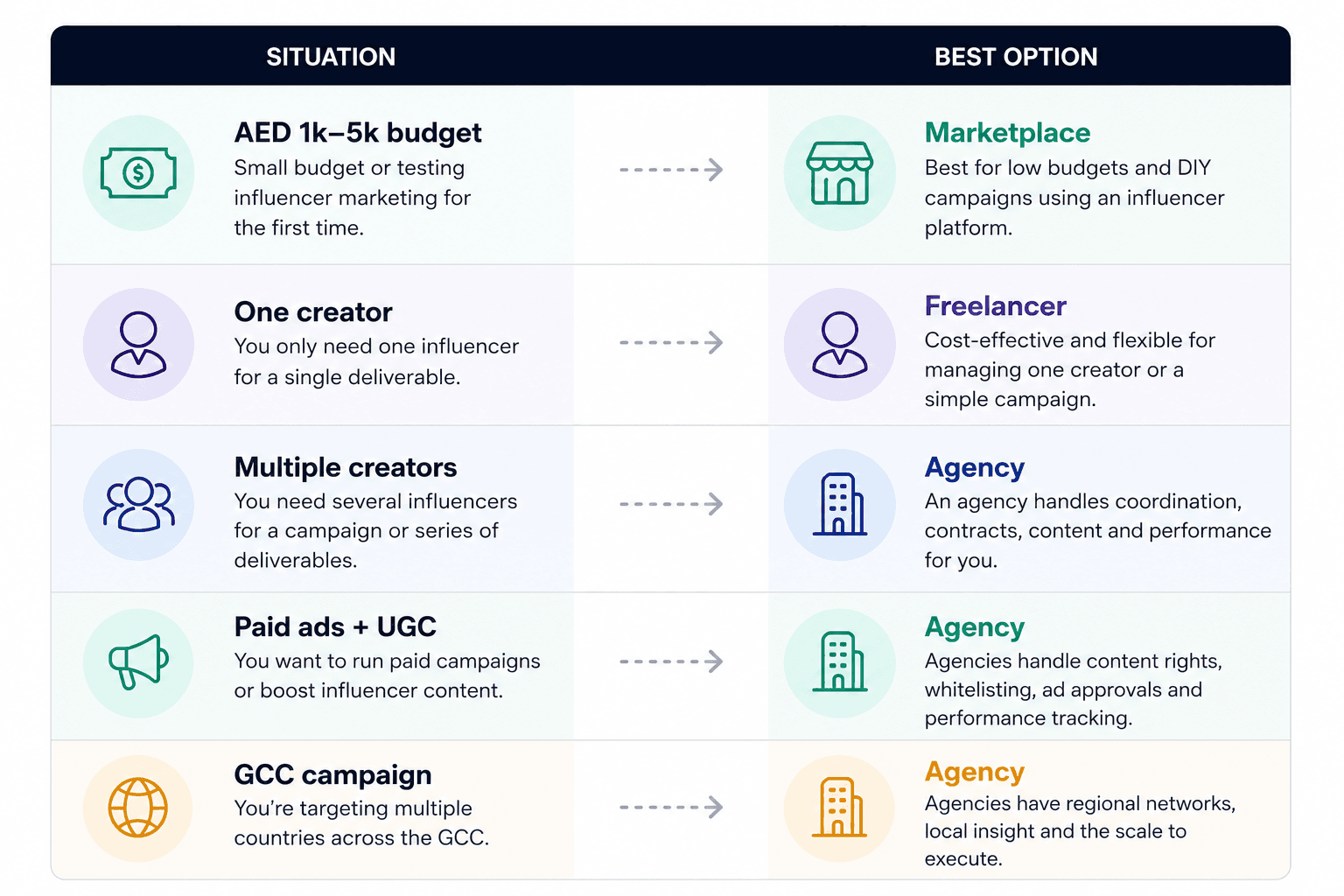
Which Option Fits You?
How to read agency case studies properly
Do not look at case studies like a portfolio. Read it like a buyer.
Start with the goal. Was the brand trying to drive awareness, bookings, sales, app installs, product trials, footfall, UGC production, or reviews? If the goal is missing, the result is impossible to judge.
The creator strategy should be transparent. You want to understand why the agency chose micro creators, lifestyle creators, Arabic creators, TikTok, Instagram Stories, event content, or a specific content format. Good agencies explain the logic behind the creator mix.
Look past the headline numbers. Reach and impressions matter, but they are not the full picture. Stronger signals: booking clicks, website traffic, CPA improvement, content assets produced, and whether any creators were used again. The Meals on Me campaign is a useful benchmark, where we engaged 32+ micro-influencers, created 64+ UGC ad assets, and got the cost per acquisition down by 35%. That is a result you can actually judge.
Ask what the content did after posting. Was it repurposed for ads, landing pages, or email? A campaign that generates 50 reusable assets is often worth more than one that generates reach. In the oneshot campaign, we used 36 creator reels with full buyout rights. These became an ad library to run in the UAE and Saudi Arabia for months after the campaign finished.
The last thing to ask is what the agency actually learned from the campaign. Which creators worked? Which formats performed? What would they change? A team that can answer those questions clearly has actually been running campaigns, not just managing them.
So, how do you choose the right influencer marketing firm Dubai brands can trust?
The right agency understands your business goal before recommending a single creator. It knows how to vet UAE audiences, manage Arabic or bilingual campaigns, handle compliance, scope usage rights correctly, and report in a way that helps your team make decisions.
For smaller campaigns (between AED 1000 and 5000), a simple creator marketplace or freelancer may be enough.
For serious Dubai campaigns (AED 10,000 and up), especially those involving paid media, UGC, micro-influencer volume, events, Arabic content, or measurable ROI, you need a proper agency layer.
Yamammi is built for that work. We manage the parts most brands do not have time to handle or want to outsource. Everything from creator sourcing, local vetting, briefs, agreements, creative direction, campaign coordination, reporting, and UGC strategy.
Want a clear plan for your next creator campaign? See how Yamammi’s influencer marketing services work.
FAQs
Related articles



Tailored shortlist for you
We make your business more money using the right creators
What brand are you growing?